
Sometimes, in our efforts to explain historical events, we create speculative narratives that go beyond the facts. Seventh-day Adventists believe that God gave prophetic visions to Ellen G. White (1827–1915) and called her to serve as a messenger to His last-day remnant church. We also know that before she received visions, two other Millerite Adventists — William E. Foy (1818–1893) and Hazen Foss (1820–1893) — had prophetic experiences. These are historical facts.
Over time, however, some Adventists concluded that God chose Ellen White only after Foy and Foss rejected their prophetic calling or somehow disqualified themselves. While there is evidence that Hazen Foss initially resisted sharing his message, the same cannot be said of William Foy. In fact, historians have noted that the stories of Foy and Foss “have often been confused and conflated” in Adventist memory.1
The life and ministry of William Foy have been carefully researched by Delbert and Benjamin Baker, revealing the remarkable story of a Black Freewill Baptist minister who faithfully shared God’s message.2 In the winter of 1842, Foy received two public visions — the first at the Twelfth Street Baptist Church in Boston on Jan. 18, 1842, and the second at the African Methodist Episcopal Church on Feb. 4, 1842. In these visions, an angel instructed him to share what he had seen.
Like many of God’s messengers throughout Scripture, Foy initially hesitated. The visions challenged some of his previous beliefs, and he also faced the painful reality of racial prejudice in 19th-century America. Yet after two days of inner struggle, Foy received an unexpected visit from J. B. Husted, the white pastor of the Second Methodist Episcopal Church in Boston. Husted invited Foy to speak to his congregation about the visions.
Although nervous at first, Foy accepted the invitation. As he spoke, his testimony deeply moved those who listened. Invitations soon poured in, and his schedule filled for months. Reflecting on that period, Foy later wrote, “I traveled three months delivering my message to crowded houses, enjoying continual peace of mind.” Once opposed to the Millerite movement, Foy became convinced through his visions of the soon return of Christ and wholeheartedly embraced the Advent message.
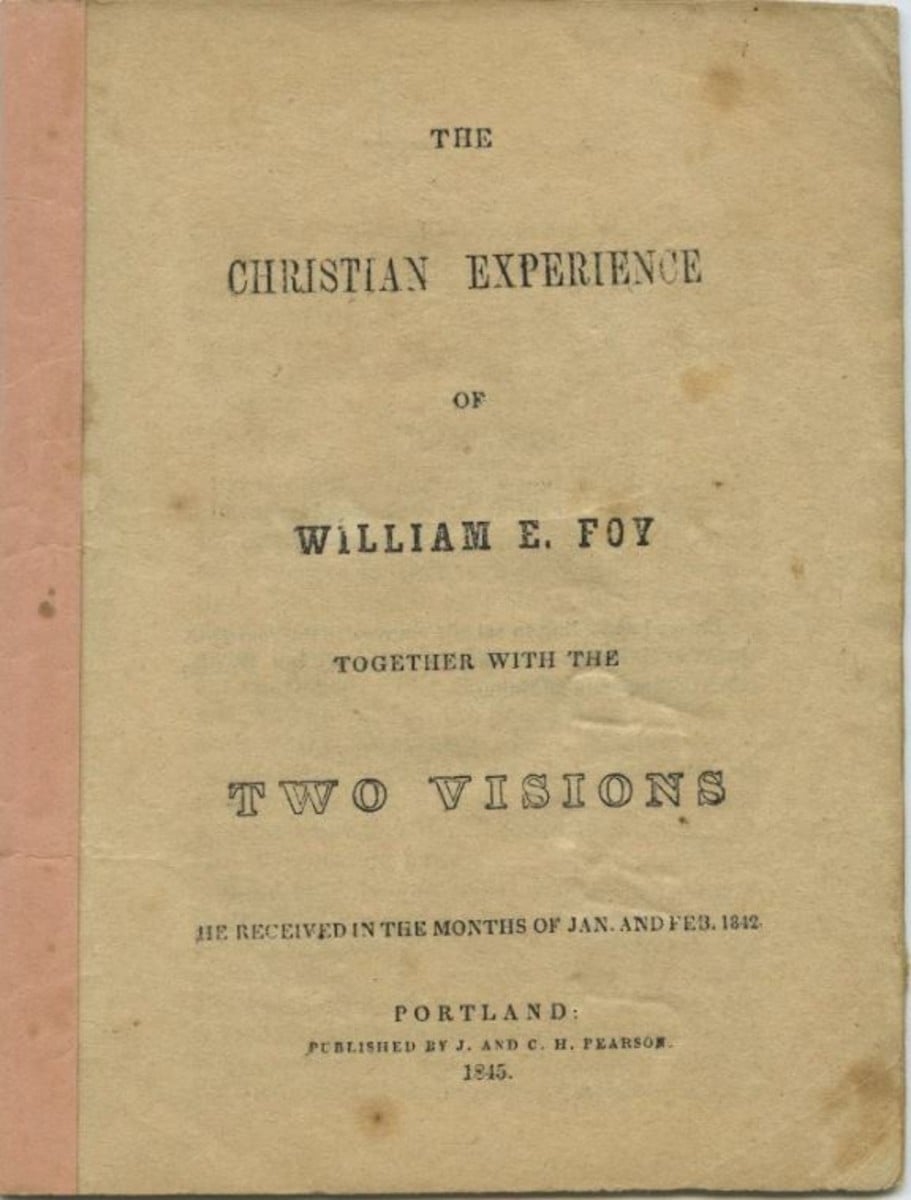
Foy continued sharing his testimony for several years. In January 1845, John and Charles Pearson published his first two visions in a 24-page pamphlet titled “The Christian Experience of William E. Foy Together with The Two Visions He Received in the Months of Jan. and Feb. 1842.” More than 60 years later, Ellen White recalled that Foy had received four visions “before I had them” and described his witness as bearing “remarkable testimonies.”3
William Foy’s story reminds us that God often works through unexpected people and circumstances. Despite social prejudice and personal hesitation, Foy responded to God’s call with courage and faithfulness. His testimony continues to stand as a powerful witness that God values willing hearts above human status and that He faithfully guides His people in every generation.
References
- This article is based on Benjamin Baker, “Foy, William Ellis (1818-1893),” Encyclopedia of Seventh-day Adventists, Dec. 30, 2020, accessed May 7, 2026, https://encyclopeida.adventist.ord/article?id=9CEN. See also Delbert W. Baker, “The Unknown Prophet: Before Ellen White, God Chose William Ellis Foy,” rev. and updated ed. (Hagerstown, MD: Review and Herald, 2013).
- See Banjamin Baker’s encyclopedia entry above, and Delbert W. Baker, “The Unknown Prophet: Before Ellen White, God Chose William Ellis Foy,” rev. and updated ed. (Hagerstown, MD: Review and Herald, 2013).
- Ellen G. White, “Interview with Mrs. E.G. White Regarding Early Experiences,” Aug. 13, 1906, Ms 131, 1906, 3-4.
Denis Kaiser is an associate professor of church history at the Seventh-day Adventist Theological Seminary at Andrews University.