
Christian Nationalism, Anti-Millerite Violence and the Adventist Witness
Racism and Religious Intolerance
In the United States, racism and religious intolerance have always coexisted. Historians have specifically shown the unfortunate truth that these forms of intolerance have plagued the Christian community throughout America’s history. Most white Christians supported slavery, Jim Crow and mass incarceration, and opposed abolitionism, the civil rights movement and Black Lives Matter. Simultaneously, Christians have often privileged white Protestant faith in American society, politics, and culture while limiting the rights of religious minorities.1
Today, racism and religious intolerance are most clearly expressed through the lens of white Christian nationalism. This political project promotes, either implicitly or explicitly, an ideology of white Christian supremacy in national politics. It is premised upon the notion that America was founded as a Christian nation and that Judeo-Christian values should be enforced through American law. This philosophy has a long history in the United States but now seems to be at the height of its power with strong support in the executive, legislative and judicial branches of American government.2
Significantly, white Christian nationalists reinterpret religious freedom as privilege. The religious studies scholar Khyati Y. Joshi has demonstrated that America has always privileged white Christians by infusing the government and society with Christian beliefs, norms and practices under the guise of pluralism. However, white Christian nationalists today are unsatisfied with this implicit power and seek to subvert religious diversity by redefining religious liberty in terms of explicit dominance. As a result, religious liberty is divested of notions of equity on the premise that tolerance does not require that religious minorities and the nonreligious be treated equally with white evangelicals.3
After analyzing data from all 50 states between 1998 and 2018, public policy professors Nilay Saiya and Stuti Manchanda found that “Christian nationalism is positively associated with antiminority violence.” Political power and rhetoric directly contribute to these violent acts as evidenced by Saiya’s and Manchanda’s finding that “states where senators articulated support for Christian nationalism recorded between 1.4 and 1.5 times the number of Christian nationalist attacks.”4 This data is supported by numerous other studies and affirmed by historians such as Matthew D. Taylor whose book, “The Violent Take It by Force,” is an insightful study of how white Christian nationalism is threatening American democracy right now.5
This is not a new phenomenon. White evangelicals have supported violence and oppression throughout their history in America, as evidenced by their treatment of racial and religious minorities. In my new book, “Apocalyptic Abolitionism: How Millennialists Helped Abolish Slavery and Reform America” (New York University Press, 2026), I demonstrate that when Adventism emerged in the 1830s and 1840s, Adventists in antebellum America opposed the racism and religious intolerance of the white evangelical majority. As Adventists confronted these issues, the evangelical majority fought back, often violently. This article recounts one of the most significant battles, which took place in Boston in October 1844.
Anti-Millerite Mobbing in Boston
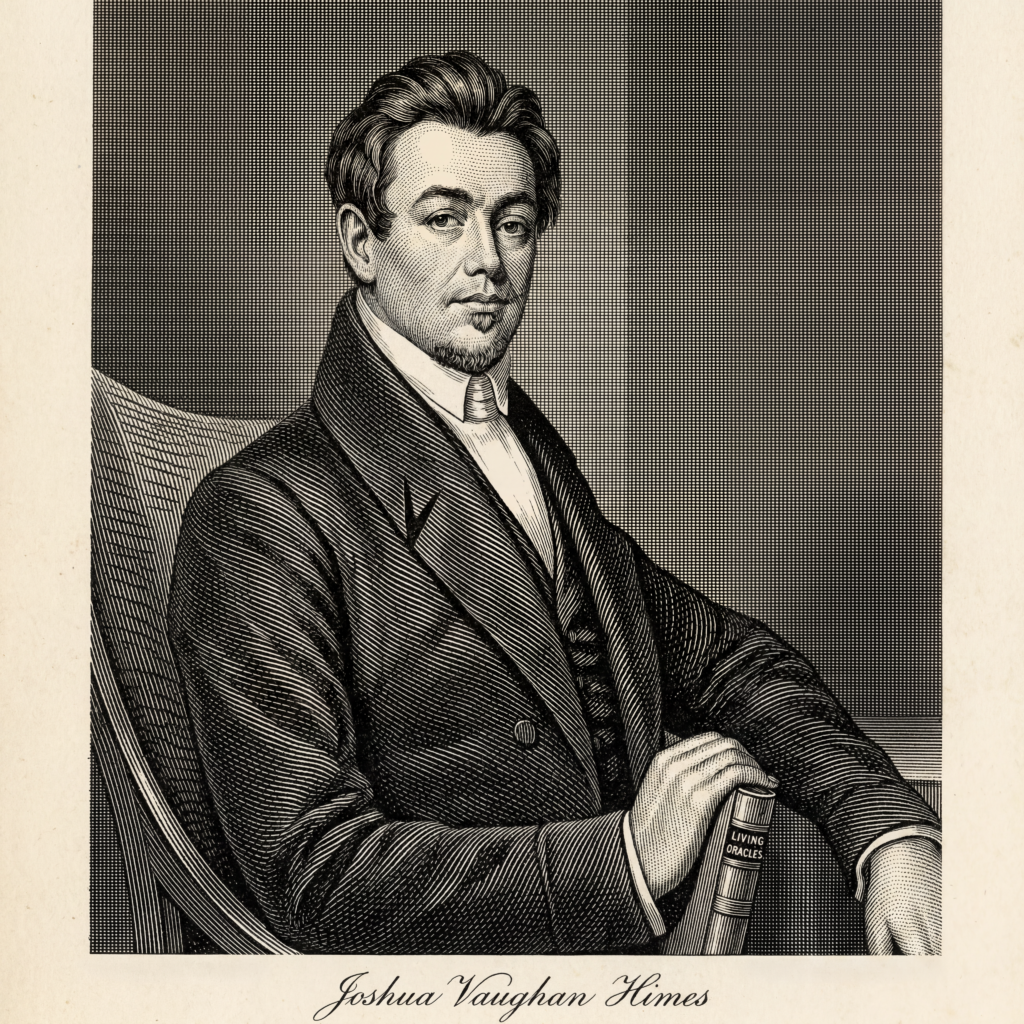
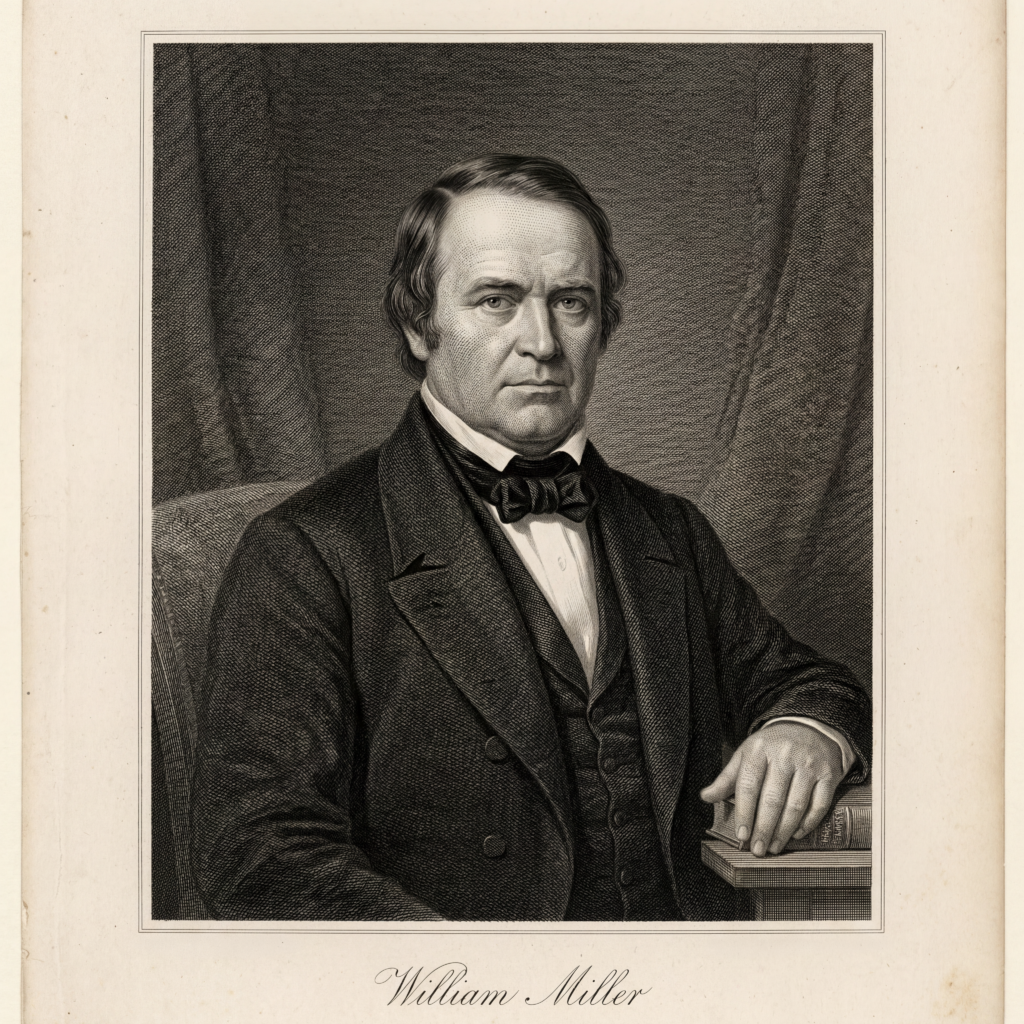
Boston served as the headquarters of the Millerite movement in the 1840s. Joshua V. Himes served as pastor, and the chapel was dedicated for worship on Nov. 7, 1838. In December 1839, William Miller lectured there for the first time, and Adventism spread like wildfire among Himes’s members. Virtually overnight, the Chardon Street Chapel became the leading Millerite congregation, with about 400 members. As Adventism rapidly spread throughout the city, Himes eventually relocated his growing congregation to the Second Advent Tabernacle, which was dedicated and opened for public worship on May 4, 1843, with about 3,500 people present. Millerite meetings continued regularly at both the Chardon Street Chapel and the Second Advent Tabernacle through the end of the year until Himes sold the Chardon Street Chapel to the Universalists in January 1844.6
White people generally believed that Millerite spaces were dangerous because they often destroyed their supremacy. One editor warned that the Chardon Street Chapel was “a kind of moral Gehenna, where all the repulsive portion of society meets and is kindled into a flame by a kind of spontaneous combustion.” This “repulsive portion” included so many Blacks that whiteness itself was lost. As this editor cautioned, “The ‘hues’ of white are chastised or changed by sable tints in all parts of the house.” If this were not frightening enough, another critic added that the home of this “motley collection of men, women, and children” also produced a “questionable odor” because it was “the rendezvous of all these mad [radical reform] societies.” Hexes were added to racist olfactory scuttlebutt and when Himes proposed to sell his chapel to accommodate his growing congregation, people speculated that this space had “been cursed with poverty and division, in consequence of opening their house to the abolitionists.”
As the Millerite excitement reached its peak in October 1844, the white majority, most of whom were evangelicals, violently attacked Millerite men, women and children in numerous places throughout the northern states. The public press generally supported such violence and called for the suppression of Millerism throughout the nation. However, non-Adventist abolitionists often defended the Millerites and stood virtually alone as the only advocates to assert that the Millerites had religious liberty rights.
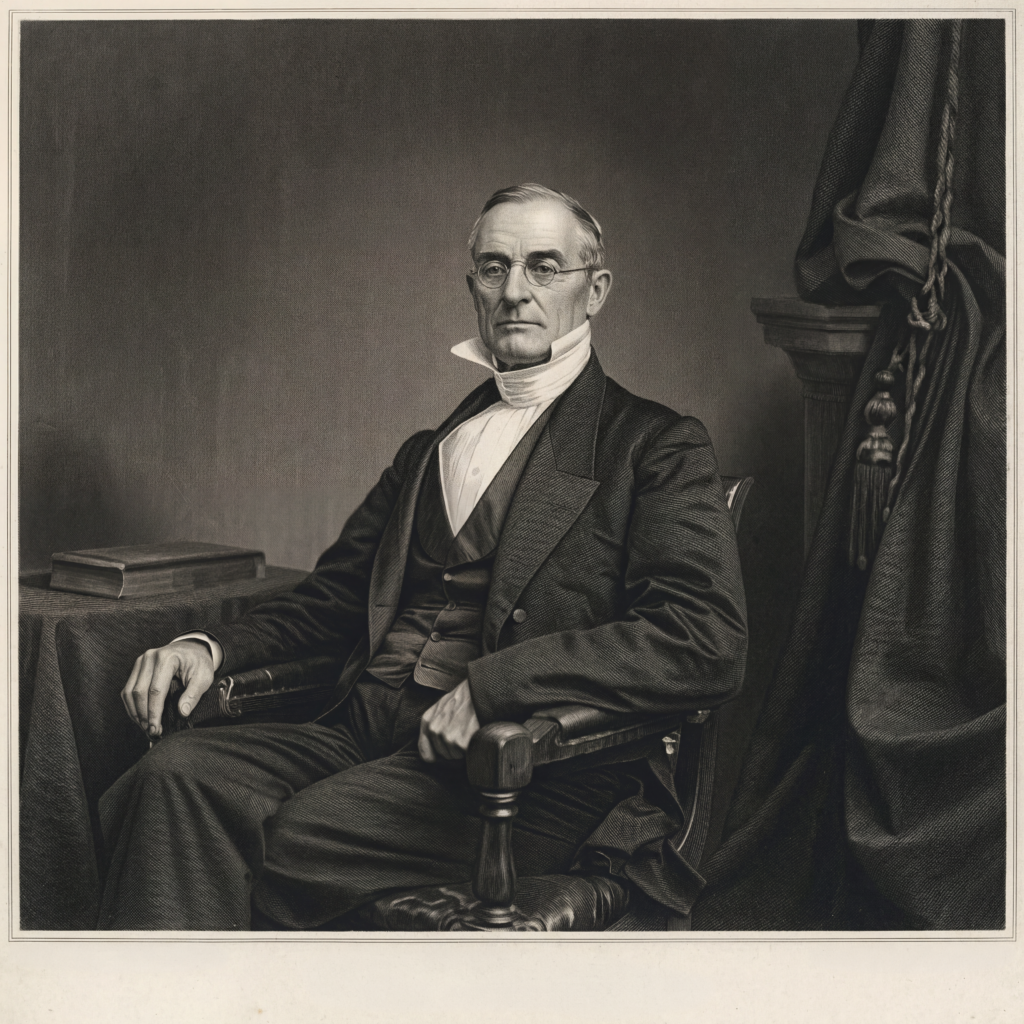
Joshua Leavitt, a leading abolitionist in Boston, was particularly censorious of anti-Adventism and in October 1844 he strongly opposed violent religious intolerance in a series of editorials. Leavitt knew many Millerites personally and refuted the notion that Adventists were kooks who abandoned their social, political or business concerns on their way to an insane asylum. Like other groups, he believed that the Millerite collective should be defined by its majority. As Leavitt explained, “We believe most of the advent people, who have adopted the new views of the approach of the Savior [i.e., that Christ would return about October 22, 1844], are honest and worthy members of society.” What made these ardent apocalypticists worthy members of society? One critical aspect, from Leavitt’s perspective, was their commitment to social reform. “Among them,” he continued, “may be found those who have been foremost in advocating temperance and in proclaiming liberty for the captive, and active in every reform.” Such diligence rendered slanderous rumors and the occasional adherent who was “destitute of moral principle” irrelevant. More importantly, the reality of Millerite respectability made anti-Adventist violence deplorable.
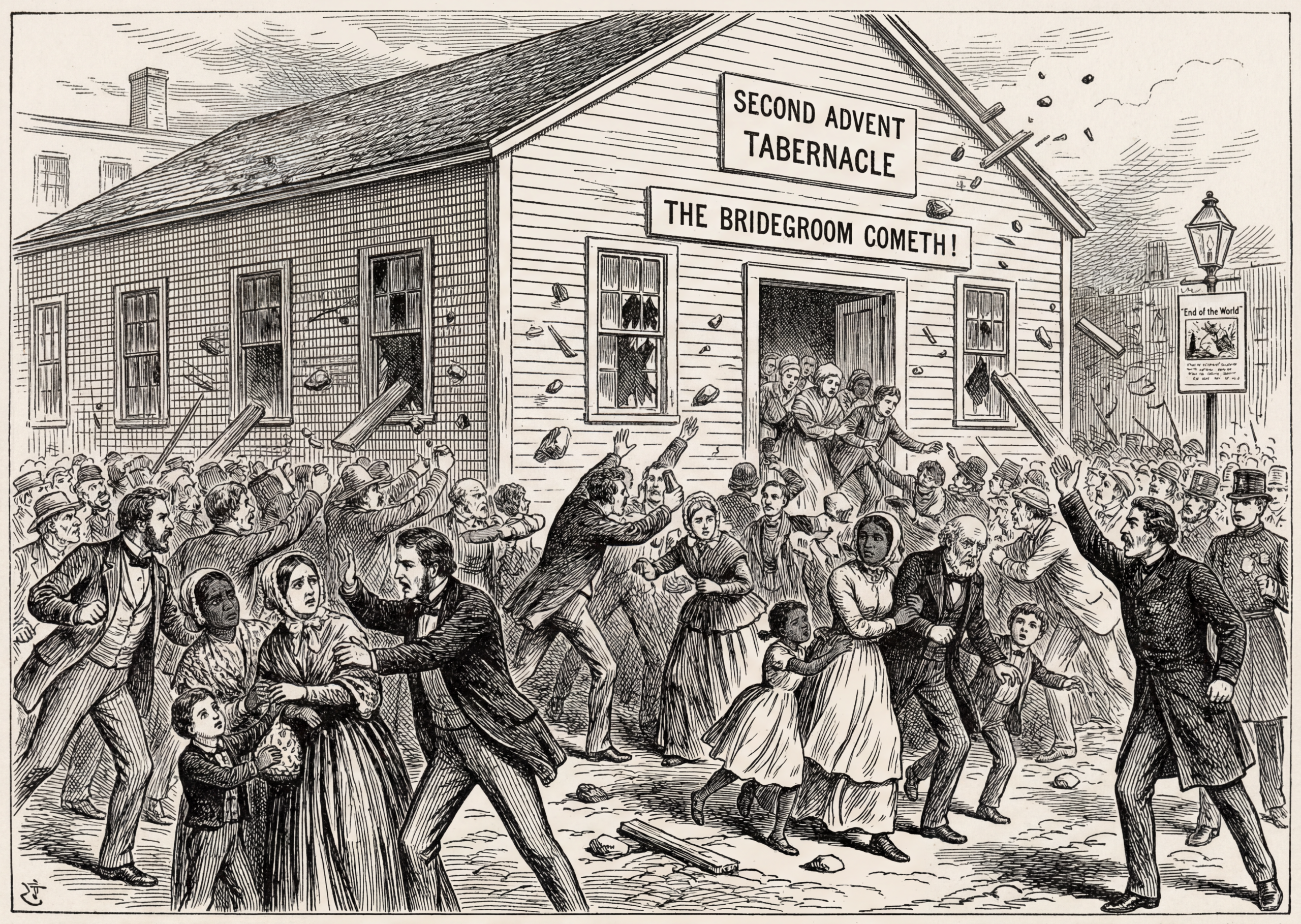
In his first editorial defending the Adventists, Leavitt reported that “a gang of desperadoes” had repeatedly mobbed the Millerites in Boston and that such violence was escalating. On Oct. 11, 1844, the Millerites worshipping in the Second Advent Tabernacle in Boston were “shamefully disturbed by a set of rowdies, who are in the habit of prowling around [their] religious meetings.” This gang launched “stones and other missiles” through the windows and skylights of the Tabernacle, which injured many Millerites and broke up their meeting. Such violence continued for several more days, and Leavitt was angered that “the press [was] either silent or covertly countenance[d] the wrong.” The Adventists were “peaceful citizens” and they had the right — like everyone else in America — “to enjoy their religion in peace.” Though some “gentlemen of property and standing” had joined the “miserable loafers” in this mob, Leavitt called on “the strong arm of the law” to end anti-Adventist violence.7
The authorities refused, and no one else in Boston joined Leavitt in defending the Millerites at this critical time. On Oct. 12, the mob broke down the Tabernacle door and rushed in to forcibly eject the Adventists from their place of worship. “Not satisfied with this outrage,” Leavitt continued, “they assailed respectable females, pushed them from the side-walks and otherwise treated them improperly.” The mob reentered the Tabernacle the next morning and “stamped with their feet, clapped their hands, broke the benches, and otherwise injured the building.” Unable to proceed over the noise and violence, Himes was forced to dismiss the meeting to prevent further injury.
By evening thousands had joined the mob, and the mayor and police finally decided to intervene. They had no interest in preserving the Millerites’ religious liberty, however, and dispersed the mob by preventing the Adventists from holding their meeting. The remaining days leading up to the Great Disappointment witnessed similar acts of violence as mobs routinely prevented the Millerites from gathering for worship. As such outrages continued, Leavitt fumed:
So it is settled that the advent people, in the city of Boston, cannot “worship God according to the dictates of their own consciences.” And the press, generally, charges them, as abolitionists were charged, a few years since, with being themselves the cause of riotous proceedings, and recommends, as ex-Gov. Everett did, in his first inaugural address, in speaking of anti-slavery men, “that they be made indictable at common law.”
This unacceptable response from the press and city officials not only “villif[ied] the character of respectable citizens,” but strengthened corruption and disgraced civilized society.8
In his defense campaign, Leavitt noted that fake Adventist literature had played an important role in fomenting violence. In October 1844, parodied print designed to infuriate the masses was widely circulated throughout the streets of Boston. One of the most prominent was a broadside, titled, “End of the World, October 22, 1844!! Behold! the Bridegroom Cometh!! Go Ye out to Meet Him!!!” As Leavitt described the document, it bore a “blasphemous wood cut” and was “accompanied by extracts from Miller’s letters and other advent documents.” Upon investigation, Leavitt had learned that it was published by “the office of a venal print, which has done its best to excite mob violence against the Adventists.”9
Leavitt also solicited a letter from Joshua V. Himes addressed to the public in response to the violence. In his letter, Himes summarized the Adventists’ beliefs and explained that since they expected Christ to return on about Oct. 22, the Millerites had desired to quietly “encourage one another in the last work of preparation.” They had not advertised their meetings or attempted “to excite either the mirth or vengeance” of white Bostonians. Though the Adventists had been greatly injured, Himes expressed no anger and did not damn the assailants to an imminent hell. Rather, he thanked the mayor and police for dispersing the mob (though the Millerites had hoped to continue worshipping) and forgave their enemies. Christ was expected in just eight days, and neither anger nor revenge was worthwhile because God was about to liberate and vindicate all his saints.10
Conclusion
The anti-Millerite riots in Boston in October 1844 are representative of a larger phenomenon in American religious history. Throughout its history, the white evangelical majority has opposed racial and religious minorities to maintain their supremacy. When the evangelical majority felt that their white Christian privilege was threatened, they often responded with draconian force, including violence. White Christian nationalists today claim to support the First Amendment and religious liberty, as have their predecessors, but their concept of freedom is not based on true equality, and they explicitly despise notions of diversity, equity and inclusion. This general trend is observable throughout the United States of America’s 250-year-history and Adventism emerged in opposition to the white Christian nationalism of the antebellum period. The Seventh-day Adventist Church has not always faithfully maintained this witness, but the pioneers have challenged us with this crucial question: will we also respond like Christ and care for “the least of these” (Matthew 25:31–46)?
Kevin M. Burton, Ph.D. is director of the Center for Adventist Research; assistant professor of Church History at the Seventh-day Adventist Theological Seminary at Andrews University; and president-elect of the Association of Seventh-day Adventist Historians.
Footnotes
1. For an introduction to this history, see Jemar Tisby, The Color of Compromise: The Truth about the American Church's Complicity in Racism (Zondervan, 2019); John Corrigan and Lynn S. Neal, Religious Intolerance in America: A Documentary History, 2nd ed. (University of North Carolina Press, 2020); John Corrigan, Religious Intolerance, America, and the World: A History of Forgetting and Remembering (University of Chicago Press, 2020); Anthea Butler, White Evangelical Racism: The Politics of Morality in America, 2nd ed. (University of North Carolina Press, 2024); Kevin M. Burton, Apocalyptic Abolitionism: How Millennialists Helped Abolish Slavery and Reform America (New York University Press, 2026).

2. For more information, see Joseph S. Moore, Founding Sins: How a Group of Antislavery Radicals Fought to Put Christ into the Constitution (Oxford University Press, 2016); Philip S. Gorski and Samuel L. Perry, The Flag and the Cross: White Christian Nationalism and the Threat to American Democracy (Oxford University Press, 2022); Jerome E. Copulsky, American Heretics: Religious Adversaries of Liberal Order (Yale University Press, 2024).

3. Khyati Y. Joshi, White Christian Privilege: The Illusion of Religious Equality in America (New York University Press, 2020).

4. Nilay Saiya and Stuti Manchanda, "Christian Nationalism and Violence Against Religious Minorities in the United States: A Quantitative Analysis," Journal for the Scientific Study of Religion 64, no. 1 (March 2025): 11, 13.

5. Matthew D. Taylor, The Violent Take It By Force: The Christian Movement That is Threatening Our Democracy (Broadleaf, 2024). See also Miles T. Armaly, David T. Buckley, and Adam M. Enders, "Christian Nationalism and Political Violence: Victimhood, Racial Identity, Conspiracy, and Support for the Capitol Attacks," Political Behavior 44 (2022): 937–60; James Piazza and Natalia Van Doren, "It's About Hate: Approval of Donald Trump, Racism, Xenophobia and Support for Political Violence," American Politics Research 51, no. 3 (May 2023): 299–314; Garen J. Wintemute, et al., "The MAGA Movement and Political Violence in 2024: Findings from a Nationally Representative Survey," Injury Epidemiology 12, no. 78 (2025): 1–18.

6. This paragraph and the next are excerpted from my book and the primary sources are cited there. See Burton, Apocalyptic Abolitionism, 55, 56–57. The remainder of this section first appeared in my dissertation. Kevin M. Burton, "The Anti-Slavery War on Evangelicalism: A Critical Interrogation of Abolitionism, Evangelicalism, and Apocalypticism" (PhD diss., Florida State University, 2023), 487–90.

7. "The Second Advent Tabernacle," Morning Chronicle, October 14, 1844, 2.

8. "The Advent Meetings Broken Up," Morning Chronicle, October 16, 1844, 3. See also Law and Order, "Mob Law Triumphant," Morning Chronicle, October 18, 1844, 1.

9. "End of the World, October 22, 1844!! Behold! the Bridegroom Cometh!! Go Ye out to Meet Him!!!," [Boston, 1844], ASC 000116, CAR; "The Advent Papers," Morning Chronicle, October 17, 1844, 3; Joshua V. Himes, "'Disturbances at the Tabernacle.' To the Public," Morning Chronicle, October 16, 1844, 3; Francis D. Nichol, The Midnight Cry (Review and Herald, 1944), 240–42, 548. This same woodcut was printed on a broadside a year earlier. "Illustrations of Miller's Views of the End of the World in 1843," [Boston, 1843], Vault Chart 0005 RH Lib, CAR. Many have assumed that these broadsides were genuine Millerite productions. Nevertheless, Leavitt correctly noted that the woodcut prominently displayed in the center was a distortion of Adventist teaching. An extensive analysis of this image is not possible here, but it should be noted that the emphasis on violence and destruction as well as a whites-only salvation were both antithetical to Adventism.

10. This letter was not published elsewhere. Joshua V. Himes, "'Disturbances at the Tabernacle.' To the Public," Morning Chronicle, October 16, 1844, 3.