
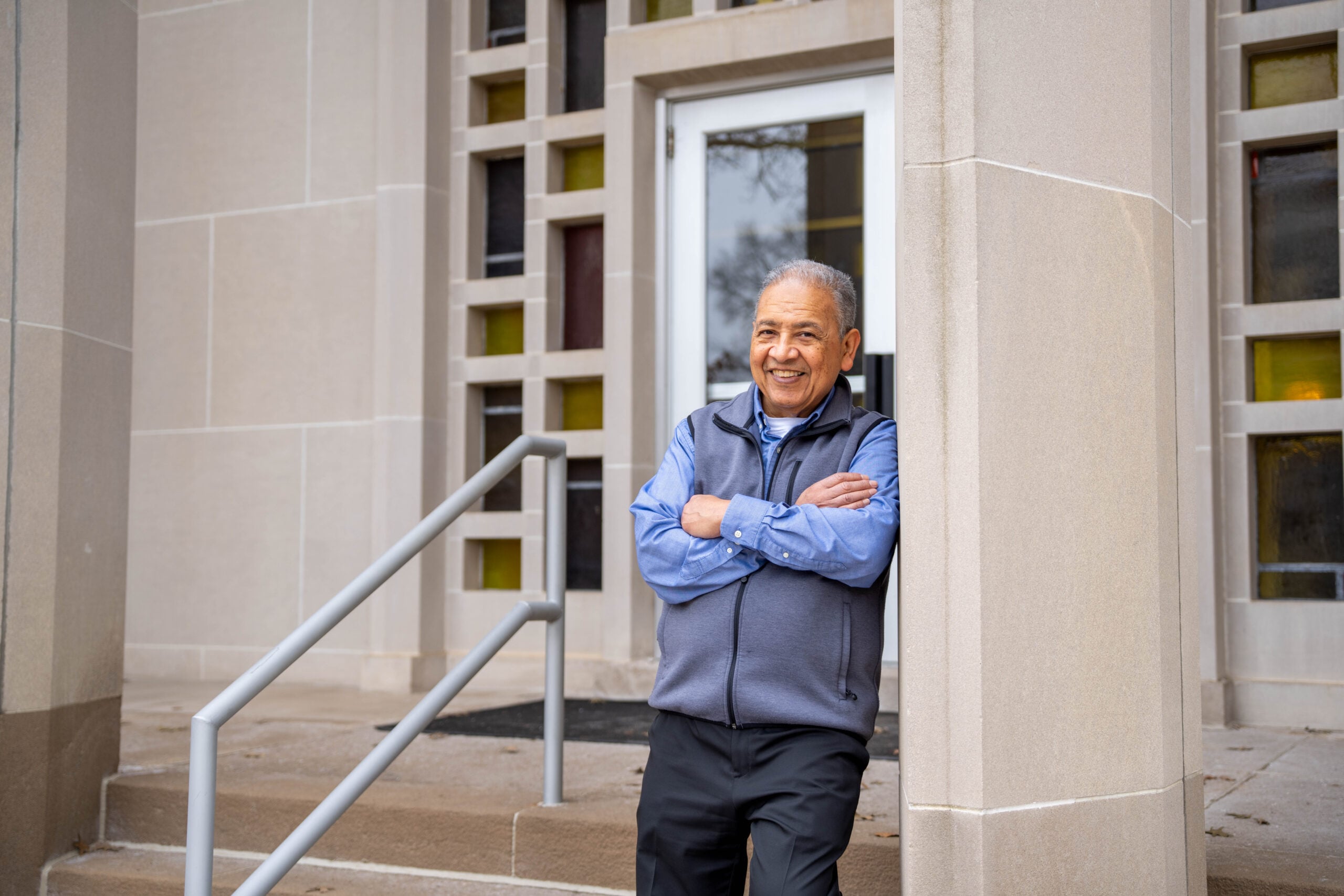
On a spring afternoon in Berrien Springs, Carmelo Mercado sits in his Lake Union office and reflects on a ministry that has spanned half a century. The years have taken him from New York City to Andrews University, from a remote town in Bolivia to church districts in Indiana, and eventually to the Lake Union Conference, where he would help shape multicultural ministry for more than two decades.
Now, as Mercado prepares to retire effective June, 1, 2026, after 50 years of service to the Seventh-day Adventist Church, I interviewed him about the positions he held and legacy he leaves behind. It’s a legacy in the bridges he built, across cultures, and generations. It’s also a lesson in how God can use a life devoted to Him to bless countless others.
Debbie Michel interviewed Mercado and the following conversation has been edited and condensed.
You’ve served the church for 50 years. Does it feel like 50 years?
Does not. Does not feel 50 years. Not at all. I’m surprised that the time has gone that fast because so much has happened in 50 years.
When I graduated in ’76, it was a dream of just working for the church. But before that, it was my dream to become a doctor. In ’74, I went as a student missionary to Bolivia because my intent was to work with a clinic. I was a pre-med biology major, and I was going to replace someone there because I was bilingual and pre-med.
I prayed about it and said, “Yeah, I guess I could take a year off.” My intention was to go to Loma Linda, though. They had even approached me about an accelerated program because of my science background. But I was also already involved in mission at Andrews, sharing my faith, singing, giving testimonies, and going into communities. So, besides the science track, I was also involved in ministry.
So how did Bolivia change things?
Before I left, they changed the call because they closed the clinic. So, they asked me if I would be willing to pastor a church, not in the highlands, but in the lowlands, in Santa Ana de Yacuma. And when I looked at that, I said, “Well, I guess I’ll do that, but that’s not what I planned.”
But we went there for a year, and it was a fabulous experience. I did Bible studies. I baptized like 15 people. When I saw the baptisms, I said, “I think I want to do this.” I just felt God’s call. I fell in love with the people and I fell in love with the work. I was all sad to leave because I had seen the miracles of people giving their hearts to God.
They called me el pastor crespo — the curly-haired pastor — because I had an Afro back then. The people I knew over there were sad to see me go.
So when you came back, you knew ministry was the direction?
Yes. I came back to Andrews and said, “I want to be a pastor,” even though I wasn’t a religion major. I had a minor in religion. I talked to Carl Coffman, who was chairman of the religion department, and said, “I want to be a pastor.” And Indiana was the conference that said they needed my help because they were having evangelistic meetings in East Chicago, Indiana, at the Spanish church there, and they needed a bi-lingual Bible worker to help out with that.
So they put me in for the summer of ’76.
It was all new to me. I didn’t even know how to drive because in New York you didn’t drive. So it wasn’t until I was in East Chicago that I took driving lessons because I knew I needed to drive sometime.
What do you remember from those early years in ministry?
East Chicago was a good experience. We baptized some people from that too. Then I went to seminary, graduated in ’79, and from there they assigned me to the Gary district, mostly working at Hammond.
Hammond was a good experience because I learned how to work with people. I made a lot of mistakes and knew right away that I had to listen and talk with people.
One story that stands out is how I met Roseanne and her family.
A request came in for Bible studies from It Is Written, from George Vandeman’s ministry. A fellow from the Spanish church who had been baptized knew the request was for someone who could teach in English, because he spoke Spanish, so he gave the request to me.
I went and visited the home. They were interested, and I offered them Bible studies. That was Roseanne’s parents, and her. They were Catholic charismatics. For a while they didn’t even know I was Adventist or a pastor. I just said, “I’m willing to give Bible studies.”
Then I invited them to church. I had already prepared the Hammond church for a visitor’s day because there were other people I was giving Bible studies to as well. So we had a good number of visitors that day, and Roseanne and her parents were part of that. I eventually baptized them in January of ’82.
The best thing that happened to me personally, I think, was that I met Roseanne and her parents and gave them Bible studies and baptized them too.
When did your relationship with Roseanne become more personal?
That same year, my mom died. She had cancer. I was so sad to see her go through that.
While I was in New York planning the funeral, I got a letter from Roseanne. We weren’t dating, but she wrote and said, “I’m so sorry that you lost your mom.” Because she knew I was hurting.
I was so touched by that letter. I fell in love with her then.
Later on we started dating. Our first date was a Valentine’s banquet. Eventually I proposed to her, and in1986 we got married.
Not long after that, you went through a terrible accident.
Yes. Six months after I got married — I was married June 1, and that will actually be my first day of retirement too, our 40th wedding anniversary — it was December of that year that we got into a terrible car accident.
We were on our way to the Indiana Conference Christmas party when a truck hit me on my side. I was severely injured. I spent a month in intensive care in Indianapolis. I had a lacerated liver, probably contusion of the heart, cracked ribs. They had to operate at least twice because I kept bleeding. At the time the doctor said, “I don’t know if he’s going to make it.”
Rosanne was injured too, but she had only a concussion. She was in the hospital maybe one night or two days. But I was there a month, and it took a while to get back on my feet. I don’t think I went back to preaching until February or March.
Did that experience shape you?
Yes, I think it did. The churches were troopers. The elders said, “We’ll take care.” They switched around and took care of things.
In some ways, it was good for them because they took more ownership of the churches. And for me, I think it deepened my sense that this was God’s work. I had been spared. I wanted to keep serving.
Over the years, what burden stayed with you the most?
Unity was always a factor for me. Working together. Working together because God says that we may be one. But we talk the talk and don’t walk the walk necessarily unless we do it together.
That’s why some of the things that stand out to me are the bi-lingual youth congresses, Conectate, the prayer conferences, women’s ministries, racial reconciliation programs.
With the youth congresses, I wanted them intentionally bilingual, intentionally where you have English and Spanish together, especially for second generation and those who are more prone to English than Spanish. My thought was that we needed to do something for the young people who feel left out.
And I wanted the young people to run the program. Typically, it was older people running things, and I didn’t want that. I wanted the pastors to serve as counselors and support, but the young people run it.
What about later, when your role expanded into multicultural ministry?
That was huge for me. The idea that multicultural would now be the domain here — we used to be Hispanic coordinator, but we expanded into multicultural.
To see people come together, work together, pray together and enjoy each other — that’s the thing I’d like to see. It amazes me to see the way we’ve been able to work with people together and cross the boundaries of race and culture.
It’s not us and them, but we. If we can see ourselves as we and working together, not seeing ourselves as, “Oh, this and that,” but just seeing ourselves as part of the same family.
Were there moments that especially stand out from your years at the Lake Union?
Yes. Journey to Healing and Understanding, focused on race relations, was a big one for me. That was different for me, and that was totally the Holy Spirit.
Then later, getting pastors together across conferences to talk about race and culture and how we can be together as one — that was really a good experience. In Detroit especially, the pastors wanted to actually have discussions from Scripture about race and cross-cultural understanding. That was really good.
Another thing that stands out is when we got the Hispanic pastors and churches from both Lake Region and Illinois together in Chicago. There had been resentment, problems, competition. I remember that first meeting with the pastors was very difficult.
But we said, “This is God’s work.” We kept meeting, kept eating together, kept talking, and by the end of those meetings one of the pastors who had been so against it said, “Pastor, I’m so sorry we’re finishing this off. This has been wonderful.”
So there was healing that took place, not just evangelism, but healing.
What has given you the most joy?
Probably the one thing that I see as really good is that people can work together and pray together — pastors, laypeople, crossing the cultural boundaries that we tend to create: black and white, Hispanic, Asian.
To see the growth of multicultural churches and members has been huge. That’s been huge. It’s a cultural shift.
When I started at Andrews in ’71, there were very few Hispanics. Very few. You could count them on maybe two hands. And now I see a lot more diversity — on campus, in the church, in the conferences.
I love it when in conference committee they mention the Korean, the Spanish, the Haitian and all that. They’re all part of the family. That’s huge from when I started.
As you look back, what do you hope people remember?
I hope we can learn to be creative, to think a little bit outside of the box. I hope we can learn to do what we feel impressed by the Spirit to do.
For whatever reason, I always felt pressed on my heart to do something to advance the kingdom, advance things for God. I’d sit down and think, and then something would come to mind, and I’d say, “Let’s do this.”
And I don’t ask for anybody to say thank you. I stay in the background. I don’t like the attention. I just want to be in the background and see it grow and go on. If someone gets the praise, fine, but I don’t want the praise. I just want to do what God wants me to do.
Love the people. Love the work. Love the people, whether they be from this culture, this background, whatever. Just love the people.
Ultimately, we’re all going to be in heaven together as one family. So why not prepare ourselves for that heaven to come by making a little bit of heaven here?