
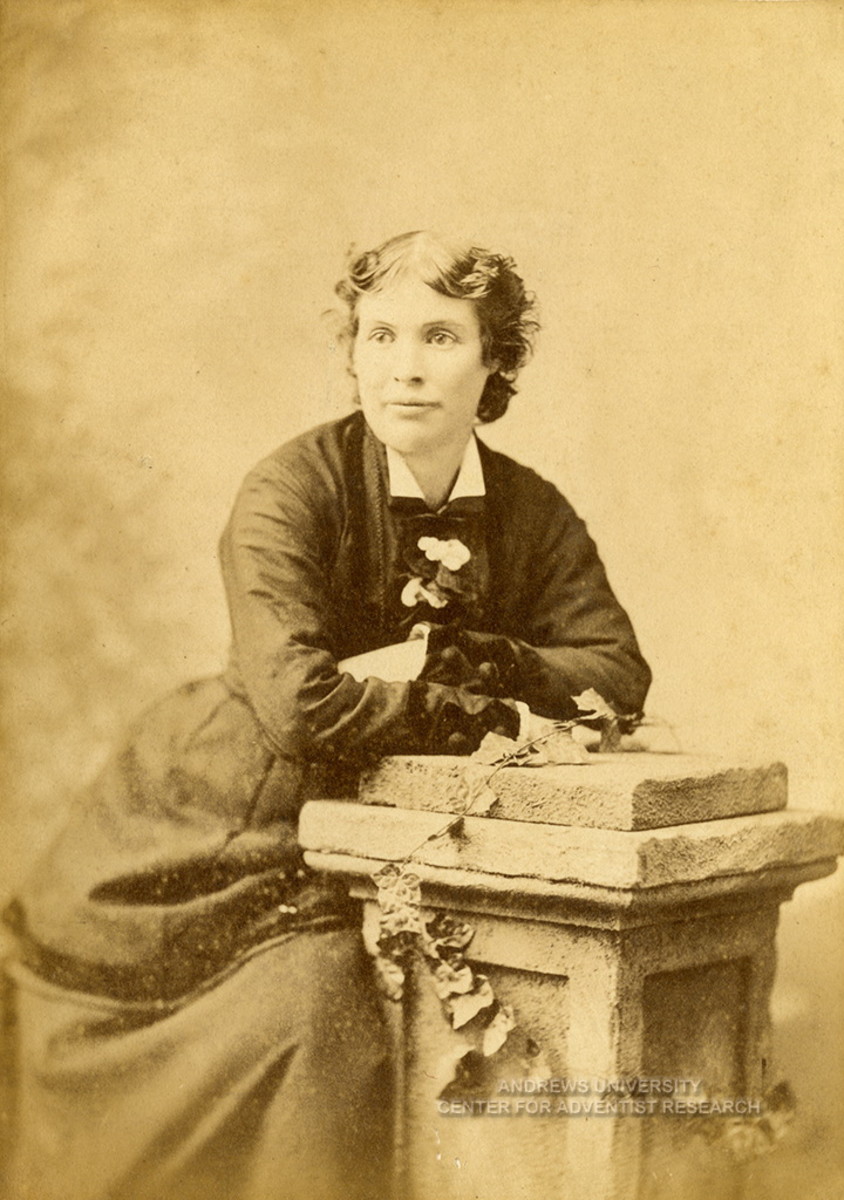
When twenty-five-year-old Catherine “Kate” Lindsay (1842–1923) arrived at the Western Health Reform Institute in Battle Creek, Michigan, in 1867, she did not step into a classroom or a medical ward. She was assigned to dust, scrub and mop. But Lindsay was paying attention.1
The young Seventh-day Adventist had left her Wisconsin home despite little encouragement from her parents and no financial support. She wanted to learn how to care for the sick. What she found in Battle Creek surprised her: the fledgling Adventist health institution had no qualified nurse on its staff. For Lindsay, that was not simply a deficiency to complain about. It became a problem to solve.
Before the year was over, she left Battle Creek and enrolled in a nursing program in New Jersey. She supported herself in part by doing family laundry. When she returned to Battle Creek in 1869, however, her training was not readily appreciated. Nursing itself was still struggling to gain recognition as a profession.
Lindsay could have lowered her expectations. Instead, she raised them. Recognizing the need for better-trained medical personnel, she decided to become a physician. In 1870 she entered the University of Michigan Medical School at a time when the admission of women was still controversial. After completing her medical education, she returned to Battle Creek in 1875.
Yet she had not forgotten what she had seen years earlier while scrubbing floors: sick people needed skilled nurses. For the next several years, Lindsay repeatedly urged John Harvey Kellogg (1852–1943) and other leaders at the Battle Creek Sanitarium to establish professional nursing education. In 1880 she pursued postgraduate medical study at Bellevue Hospital in New York and observed its nursing school, which had been reorganized according to principles associated with Florence Nightingale (1820–1910).
Then, in the spring of 1883, the vision became reality. The Battle Creek Sanitarium opened the first Seventh-day Adventist school of nursing. Its first course lasted only three months, and just two women completed it. The program soon expanded, however, and Adventist nursing education eventually spread far beyond Battle Creek and the United States.
There is something striking about where this story began. Kate Lindsay did not arrive at Battle Creek with authority, money, or even a professional title. She arrived with a willingness to work, and eyes open enough to notice what was missing. Christian service sometimes begins that way. We see a need others have learned to accept. We ask why things must remain as they are. And then, with persistence, education, and faith, we become part of the answer. The woman who once scrubbed the floors of an Adventist health institution helped prepare generations of people to care for those who walked through its doors.
This article is based on Lorena M. Jeske, “Lindsay, Catharine ‘Kate’ (1842–1923),” Encyclopedia of Seventh-day Adventists, Jan. 28, 2020, accessed Sept. 2, 2026, https://encyclopedia.adventist.org/article?id=69OS.
Denis Kaiser is an associate professor of church history at the Seventh-day Adventist Theological Seminary at Andrews University.