
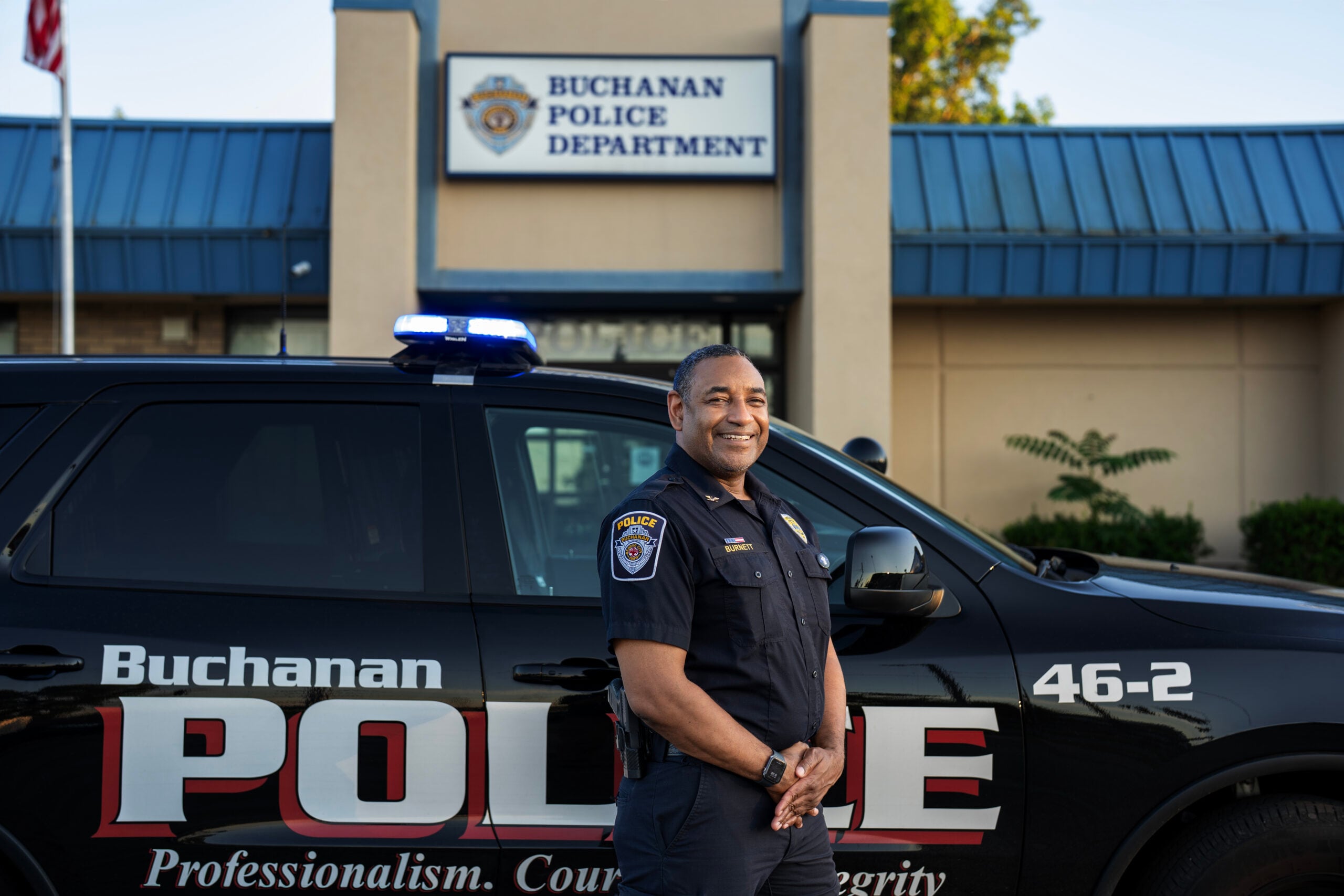
For Harvey J. Burnett Jr., some days begin in a classroom at Andrews University and end at the Buchanan Police Department. The setting may change, but his purpose does not.
“I’m not walking by sight,” Burnett said. “I’m walking by faith.”
For Burnett, faith is not something reserved for a specific place or time. It is something he carries with him, shaping how he leads in the classroom, how he responds in moments of crisis, and how he serves in the community. Over time, that belief has guided a career that stretches across education, law enforcement and public service.
Burnett, a licensed psychologist in the state of Michigan, is a professor of psychology and chair of the School of Social & Behavioral Sciences at Andrews University. He is also the chief of police for the city of Buchanan and has spent nearly three decades on the city’s Board of Education, including years serving as its president. Each role carries its own responsibilities, but Burnett does not see them as separate paths.
“I look at my roles as one larger calling, to be true to God and serve Him by serving others,” he said.
His path into that calling was not carefully planned. After completing seminary, Burnett entered law enforcement out of necessity, looking for stable work to support his family. What began as a practical decision gradually took on deeper meaning as he encountered people facing trauma, loss and crisis. Those experiences led him to pursue a doctorate in counseling psychology at Andrews University, building on earlier studies in psychology at the University of Michigan-Dearborn and theological training at the Seventh-day Adventist Theological Seminary.
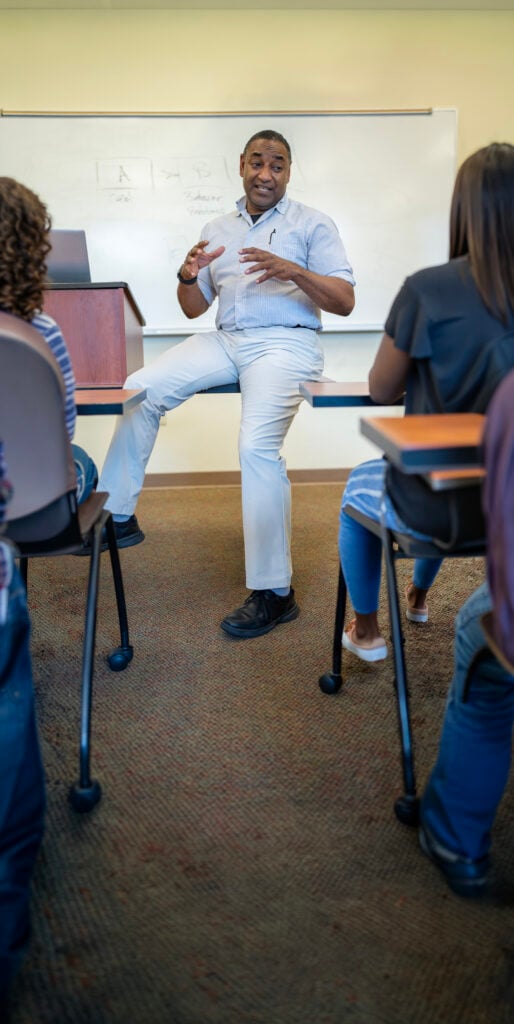
Over time, the lines between his roles began to blur. His background in psychology informed how he approached law enforcement. His experience in policing shaped how he engaged students. His work in both spaces influenced how he approached leadership within the community.
“The roles overlap in leadership…working with a diversity of individuals and meeting the needs of the community,” he said.
INSIDE THE CLASSROOM
On the campus of Andrews University, where Burnett has worked for over 20 years, that overlap becomes visible in the way he leads. Stacie Hatfield, an assistant professor at the School of Social & Behavioral Sciences, said Burnett’s leadership is defined by reliability, especially during times of uncertainty.
“His consistent leadership, his calm, steady demeanor in the face of a great deal of change, has been an inspiration to me,” Hatfield said. As a mentor, she adds, “His breadth of understanding and administrative experience have been beneficial to helping guide our department.”
That same presence extends into the classroom. Ava Gruia, a sophomore psychology major, says Burnett’s ability to draw from real-world experience makes his classes feel different.
“He’s been able to use those experiences and apply that to the classroom,” she said.
Students often ask him about his work outside the classroom, she adds.
“We always ask him about being a cop and how that applies to what’s going on,” she says. “He’s very open about those things.”
That openness, she says, helps connect what students are learning to what they see happening in the world around them.
Gruia said Burnett’s faith also shapes how he interacts with students. “I think it definitely plays a big part in how he approaches everything,” she said. “He just makes the classroom feel real.”
LAW ENFORCEMENT
Outside the University, Burnett’s work continues in a setting where decisions often carry immediate consequences. As chief of police in Buchanan, he leads a department while also serving in roles that connect law enforcement to the broader community.
Patrol Officer Philip Huang, a school resource officer, says Burnett’s experience gives him a perspective that goes beyond standard procedure.
“He has his hands in a million roles,” Huang said. “It’s kind of cool to have a chief that just knows the ins and outs of the community.”
That perspective, Huang said, changes how officers approach situations.
“You can always ask him how to approach a situation, and he’s opened my mind to look at things from different perspectives,” he said.
Huang said Burnett’s leadership is especially evident when people need help, as he connects families with resources through relationships built across the community.
“Anything that he can do with volunteering or any community thing that he can do, he does it,” Huang said. “Sometimes all someone needs is a little help.”
SCHOOL BOARD
Burnett’s connection to the community also runs through his long-standing work with Buchanan Community Schools. Serving 27 years on the Board of Education has placed him at the center of critical decisions that shape the district.
Superintendent Patricia Robinson said his presence has been steady over time. She described his leadership as calm and thoughtful, particularly in situations that require clarity and perspective.
“He shows up with a very calm demeanor and a lot of insight into helping students and staff, especially with mental health,” she said.
Robinson said his approach reflects something deeper than professional experience.
“You can definitely tell that it is spiritually led and comes from a faith-based background,” she said. “His suggestions are always helpful and give people strategies to move forward.”
FAITH: THE DRIVING FORCE
Across each of these spaces, Burnett does not separate faith from responsibility. Instead, it becomes the foundation for how he approaches his work.
“I look at my roles as one larger calling,” he says, “[to] be true to God and serve Him by serving others just as He has done for us, especially dying on the Cross in my place for my sins.”
“Being on the frontlines” for God’s kingdom can look like many things for Burnett: helping students integrate their faith with what they’re learning; reflecting God’s love in interactions, even amid opposition; and caring for personnel and community members.
Burnett’s understanding of faith has been shaped through personal loss. More than a decade ago, the death of his youngest daughter forced him into a season where belief was tested in deeply personal ways.
“I was angry at God and felt that He let me down,” he shares.
The experience did not resolve quickly, and the answers he sought did not come easily.
“Although I was angry and hurt, I kept holding on to Him,” he says. “I had to be honest with God and doing that helped me find resolution and peace. Now it is my testimony how a loving God understands and helps one through a tragic time in life.”
Over time, that experience reshaped how he understands faith, not as something that removes hardship, but as something that remains present through it.
Burnett’s days remain full, filled with teaching, meetings, mentoring and community responsibilities that often extend beyond a typical schedule. Across classrooms, patrol work and school board meetings, what sustains him, he said, is not simply routine, but a steady reliance on faith. Prayer, his community, Bible verses and Christian music keep him grounded.
Burnett understands that not every space allows for direct conversations about faith. Still, he believes it can be seen in the way a person lives. The roles may change from one moment to the next, but the direction does not.
“I may not be able to outright evangelize,” he says, “but I can be Christ to others in how I treat them.”
Nicholas Gunn is a communication major at Andrews University.